Detention Time Formula: Tanks, Basins, Pipes and Water Age
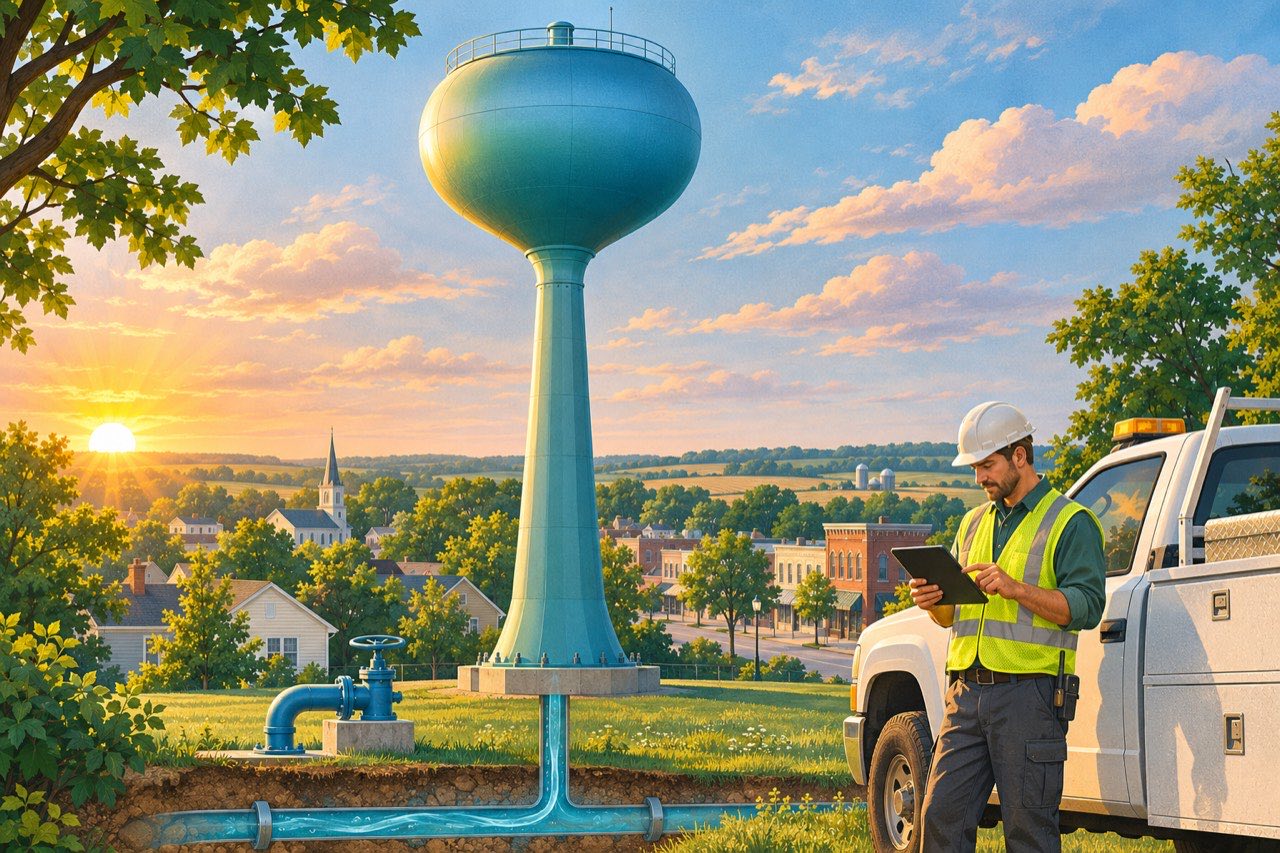
The detention time formula is Detention Time = Volume ÷ Flow, with both in compatible units. Gallons ÷ gpm gives minutes, gallons ÷ gpd or MG ÷ MGD gives days (multiply by 24 for hours). Find the volume first: a round tank holds 0.785 × D² × H × 7.48 gallons, and a rectangular basin holds L × W × H × 7.48 gallons.
Key takeaways
- DT = Volume ÷ Flow. The units of the answer come from the units you divide.
- gal ÷ gpm = minutes; MG ÷ MGD = days; days × 24 = hours.
- Round tank or pipe: 0.785 × D² × H (or L) × 7.48 = gallons. Rectangular basin: L × W × H × 7.48.
- For CT, EPA uses T = theoretical detention time × baffling factor, at peak hourly flow.
- Long detention in tanks and mains means older water: lower chlorine residual and more disinfection byproducts.
What is the detention time formula?
Detention time is how long water stays in a tank, basin or pipe. It is also called residence time or retention time. The Water Professionals International (WPI) formula table writes it as Detention Time = Volume ÷ Flow, with the note that units must be compatible.
The math is one division. The trap is units: gallons over gallons per minute gives minutes, million gallons over million gallons per day gives days. Get both numbers into matching units before you divide.
| Volume in | Flow in | Answer comes out in | To get hours |
|---|---|---|---|
| gallons | gpm | minutes | ÷ 60 |
| gallons | gpd | days | × 24 |
| MG | MGD | days | × 24 |
| ft³ | ft³/s (cfs) | seconds | ÷ 3,600 |
| gallons | MGD | convert MGD to gpm first (1 MGD = 694.4 gpm) | ÷ 60 |
How do you find the volume of a tank or basin?
Detention time questions almost always make you compute volume first. The WPI formula table gives the volume of a cylinder as 0.785 × D² × H and a rectangular tank as L × W × H. Both give cubic feet when you use feet, and 1 ft³ holds 7.48 gallons.
For a pipe, the same cylinder formula applies with length in place of height. Convert the pipe diameter from inches to feet before you square it: an 8-inch main is 0.667 ft, a 12-inch main is 1 ft.
- Round tank or standpipe: gal = 0.785 × D² × H × 7.48
- Rectangular basin or clearwell: gal = L × W × H × 7.48
- Pipe: gal = 0.785 × D² × L × 7.48 (D in feet)
- Gallons to MG: divide by 1,000,000
Worked examples: tanks, clearwells, pipes and basins
Example 1, a distribution storage tank. A standpipe is 50 ft in diameter with 34 ft of water. Volume = 0.785 × 50² × 34 × 7.48 = 499,103 gal. With the well off and 300 gpm going out, DT = 499,103 ÷ 300 = 1,663.7 min, and 1,663.7 ÷ 60 = 27.7 h (rounded). If the same tank only cycles about 125,000 gal a day, a rough, fully mixed estimate of average water age is 499,103 ÷ 125,000 = 3.99 days.
Notice the two questions use the same formula with different flows. The first asks how long storage lasts in an outage, so the flow is total demand. The second asks how old the water is, so the flow is what actually moves through the tank each day. Pennsylvania DEP's distribution training warns that excessive detention time in a storage facility can deplete the chlorine residual, and that it happens when not enough water moves in and out on a routine basis, from low system demand, improperly designed storage or improper operation.
Quick check on any answer: a bigger volume or a smaller flow must give a longer time. If your detention time went down when flow dropped, the division is upside down.
How is detention time used for CT in a clearwell?
Example 2, a clearwell for CT. EPA's Disinfection Profiling and Benchmarking guidance calculates contact time as T = theoretical detention time (TDT) × baffling factor (BF), using peak hourly flow, and suggests the minimum operating volume as the most conservative choice. A rectangular clearwell is 60 ft × 30 ft with a 12 ft minimum depth, and peak hourly flow is 1,000 gpm.
Volume = 60 × 30 × 12 × 7.48 = 161,568 gal. TDT = 161,568 ÷ 1,000 = 161.6 min. With poor baffling (BF 0.3 in EPA's table), T = 161.568 × 0.3 = 48.5 min. At a 1.0 mg/L free chlorine residual, CT = 1.0 × 48.47 = 48.5 mg·min/L. The CT you actually need depends on temperature, pH and the required inactivation, so it comes from your state and the EPA CT tables.
| Baffling condition | Baffling factor (EPA Table 4-2) |
|---|---|
| Unbaffled (mixed flow) | 0.1 |
| Poor | 0.3 |
| Average | 0.5 |
| Superior | 0.7 |
| Perfect (plug flow, pipeline) | 1.0 |
Detention time in a pipe and a sedimentation tank
Example 3, a pipe segment. A mile (5,280 ft) of 12-inch main carries 200 gpm during the day. Volume = 0.785 × 1² × 5,280 × 7.48 = 31,003 gal. DT = 31,003 ÷ 200 = 155.0 min, about 2.6 h. At night, with 50 gpm, DT = 31,003 ÷ 50 = 620.1 min, about 10.3 h. Same pipe, four times the age, just because use dropped.
Example 4, the detention time formula for a sedimentation tank. A rectangular basin is 80 ft long, 20 ft wide and 12 ft deep and treats 1.0 MGD. Volume = 80 × 20 × 12 × 7.48 = 143,616 gal = 0.143616 MG. DT = 0.143616 ÷ 1.0 = 0.1436 days, × 24 = 3.45 h. Check in gpm: 1.0 MGD = 694.4 gpm, so 143,616 ÷ 694.4 = 206.8 min = 3.45 h. Both routes agree.
Example 5, MG over MGD. A 2.0 MG reservoir serving 0.5 MGD with no inflow: 2.0 ÷ 0.5 = 4 days, × 24 = 96 h.
Why does detention time matter in distribution?
In a distribution system, detention time is water age. EPA's water age fact sheet defines water age as the time water spends in the distribution system before use, and says it can become excessive when use is low, when pipes or tanks are larger than needed, or when circulation is poor.
The EPA distribution system issue paper Effects of Water Age on Distribution System Water Quality (prepared by AWWA) calls water age a major factor in water quality deterioration. It lists the problems that get worse with age: disinfection byproduct (DBP) formation, decay of chlorine and chloramine residual, nitrification in chloraminated systems, and microbial regrowth. Warmer water speeds these reactions up.
That is why operators deepen daily tank drawdown, flush dead ends and loop mains. The paper notes that daily turnover can be increased to reduce overall water age.
Common detention time mistakes
Practice a few problems of each type and the units stop being a trap. The formula page lists every conversion you need on one screen.
- Dividing gallons by MGD. Convert MGD to gpm (× 694.4) or gallons to MG first.
- Forgetting × 7.48. ft³ ÷ gpm is not minutes.
- Leaving diameter in inches before squaring.
- Using the radius in 0.785 × D². The 0.785 already includes the divide-by-4.
- Using full-tank volume for CT without checking with your state. EPA calls minimum operating volume the most conservative choice.
- Reporting minutes when the question asks for hours.
Practice this now — free
Make volume ÷ flow automatic
Practice detention time, tank volume and unit conversion problems with full worked answers.
Take the free practice test →Frequently asked questions
What is the formula for detention time?
Detention time = volume ÷ flow, in compatible units. Gallons ÷ gpm gives minutes; MG ÷ MGD gives days.
How do you calculate detention time for a sedimentation tank?
Find the volume with L × W × H × 7.48, then divide by flow. An 80 × 20 × 12 ft basin holds 143,616 gal; at 1.0 MGD (694.4 gpm) that is 206.8 minutes, or 3.45 hours.
Is detention time the same as residence time?
Yes, in water operator math the terms are used for the same idea: volume divided by flow. In a distribution system the same idea is called water age.
How do you convert detention time from days to hours?
Multiply days by 24. A 2.0 MG reservoir at 0.5 MGD has a detention time of 4 days, which is 96 hours.
Why is long detention time a problem in storage tanks?
Older water loses chlorine residual and forms more disinfection byproducts, and EPA links high water age to nitrification and microbial growth. Increasing daily turnover lowers water age.
Sources
- WPI Formula/Conversion Table (2024), posted by Virginia Department of Health ↗
Detention Time = Volume ÷ Flow (units must be compatible); volume of cylinder and rectangular tank; 7.48 gal/ft³; 1 MGD = 694 gpm
- US EPA, Disinfection Profiling and Benchmarking Technical Guidance Manual (EPA 815-R-20-003) ↗
T = TDT × BF; peak hourly flow; minimum volume most conservative; Table 4-2 baffling factors
- US EPA Distribution System Issue Paper: Effects of Water Age on Distribution System Water Quality (2002) ↗
Water age a major factor in deterioration; DBPs, residual decay, nitrification, regrowth; turnover
- US EPA Distribution System Toolbox fact sheet: Protecting Water Quality Through Water Age Management ↗
Definition of water age and causes of excessive water age
- PA DEP Drinking Water Operator Training, Module 8: Distribution System ↗
Excessive detention time depletes chlorine residual
Mainsora is independent exam preparation, not affiliated with ABC/WPI, AWWA, EPA or any state certification program. Requirements change — confirm with your state program. See our editorial policy.