How to Pass the Water Distribution Exam: A 4-Week Plan
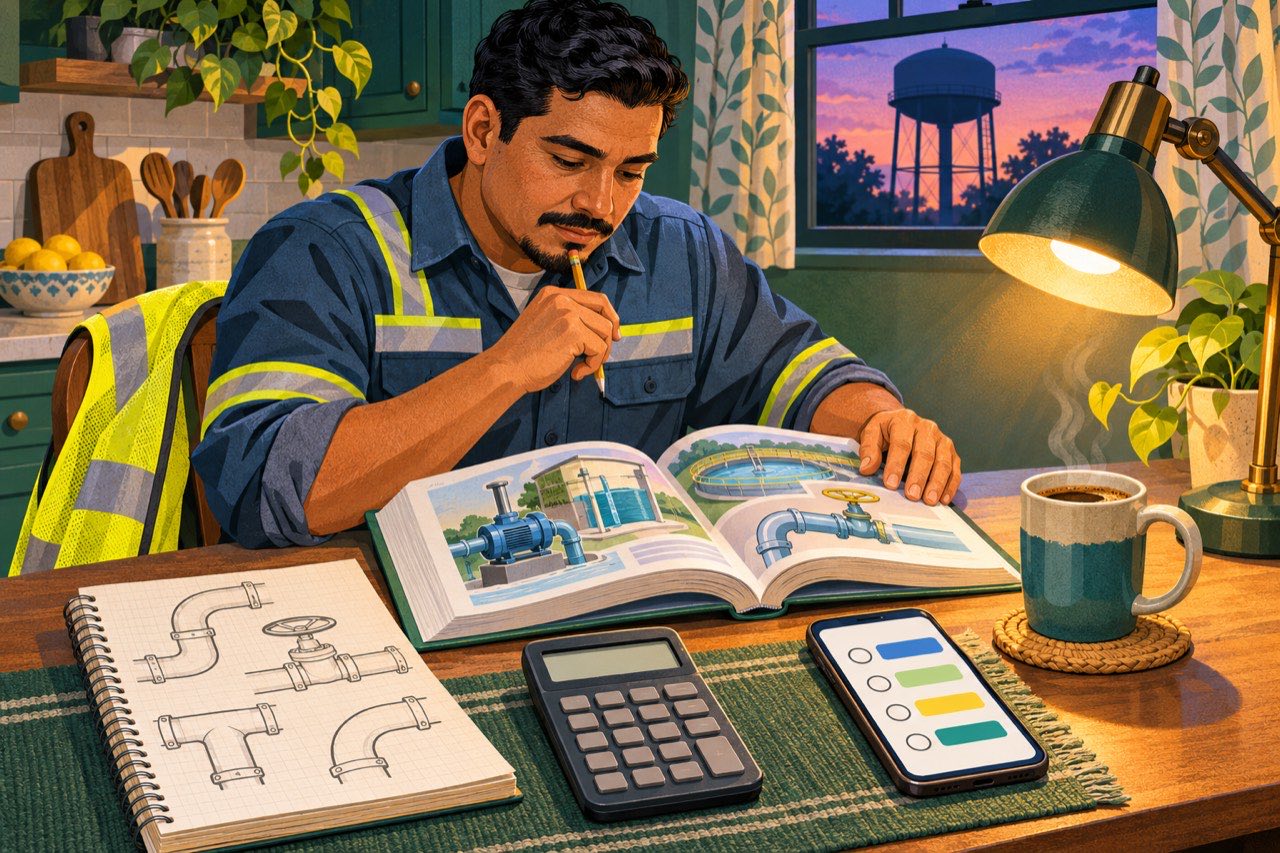
How to pass the water distribution exam: first confirm which exam your state uses, then study by the official content outline: on the WPI (formerly ABC) Class I exam, 65 of 100 scored questions cover system components and installation, operation and repair. Practice the math with the formula sheet you will actually get, take timed practice tests, and review every miss. Many states set the passing score at 70%.
Key takeaways
- Find your exam first: WPI/ABC standardized, or state-written. Question counts, time and passing score differ.
- Study by weight. On the 2025 WPI Class I outline, components (35) and installation, operation and repair (30) are 65 of 100 scored questions.
- Learn the math on the same formula/conversion table you will get on test day, and write units on every line.
- Pace yourself: Ohio allows 180 minutes for 110 items, about 1.6 minutes each.
- Retake waits vary, from two business days in Maine to 90 days in Minnesota. Check your state.
Which water distribution exam are you taking?
Start here, because the exam is not the same everywhere. Many states use the standardized exams from Water Professionals International (WPI, formerly ABC); others write their own. Look up your state page for the provider, question count, time limit and passing score.
WPI's Class I distribution exam has 100 scored questions plus up to 10 unscored pre-test questions. State-written exams can be shorter: Florida's has 50 questions and Wisconsin's has 40. A score of 70% is common, but Delaware requires 75% and Maryland 69.5%.
| State | Exam | Questions | Time | Passing score |
|---|---|---|---|---|
| Ohio | WPI (ABC) | 110 (100 scored) | 180 min | 70 |
| Arkansas | ABC/WPI | 110 (10 unscored) | 180 min | 70% |
| South Dakota | ABC | 110 (graded on 100) | 180 min | 70% |
| Florida | State-written | 50 | 120 min | 70% |
| Wisconsin | State-written | 40 | 3-hour session | Not confirmed |
| Delaware | Not confirmed | Not confirmed | Not confirmed | 75% |
What topics carry the most weight?
WPI publishes a free Need-to-Know Criteria for each class. It lists how many questions come from each content area, so you can spend your time where the points are.
On both outlines below, field knowledge of pipes, valves, hydrants, pumps and storage makes up the largest share. Math is a smaller slice: 9 of 100 scored questions on Class I and 11% of the Class II exam are calculations. But the math also sits behind disinfection, flushing and pressure questions, so it is worth practicing until it is routine.
State-written exams publish their own outlines. Florida lists administrative duties, regulations, installing, maintaining and operating equipment, disinfection, system design and inspection, water quality, safety and security, and math. New Mexico's DS1 guidebook lists 28 questions on mechanical systems and 15 on distribution.
| WPI content area (2025) | Class I questions | Class II questions |
|---|---|---|
| Distribution system components | 35 | 32 |
| Equipment installation, operation, maintenance and repair | 30 | 28 |
| Water quality monitoring, evaluation, adjustment and lab analysis | 15 | 20 |
| Security, safety, administrative procedures and public interactions | 20 | 20 |
| Calculation questions (within the areas above) | 9 | 11 |
How to pass the water distribution exam in 4 weeks
This plan assumes you work full time and can study most days. Stretch it if your exam date allows. Take the free practice test on day one so you know where you stand, and take it again at the end of each week.
- Week 1: Read your state page and WPI's Need-to-Know Criteria or your state outline. Download the formula sheet you will get. Learn area, volume and unit conversions: 0.785 × D², 7.48 gal/ft³, 8.34 lb/gal.
- Week 2: System components. Pipe materials and joints, thrust restraint, valves, hydrants, meters and service lines, storage tanks and pumps. Add the pressure and flow math: 2.31 ft/psi, 0.433 psi/ft, Q = A × V.
- Week 3: Disinfection and water quality. Free, combined and total chlorine, dose = demand + residual, the pounds formula, new-main disinfection, coliform sampling, lead and copper, and public notice. Finish with backflow devices.
- Week 4: Safety and administration (trenching, confined spaces, lockout, records, customer calls). Then take full-length timed practice exams, review every miss and re-read only the weak topics.
| Week | Focus | Practice |
|---|---|---|
| 1 | Exam rules, math basics | Baseline practice test; 10 volume and conversion problems |
| 2 | Mains, valves, hydrants, storage, pumps | Pressure, head and flow problems |
| 3 | Disinfection, water quality, regulations, backflow | Dose and pounds-formula problems |
| 4 | Safety, admin, full review | Timed full-length practice exams |
How do you get the math right on the exam?
Most math misses are setup errors, not arithmetic. Convert inches to feet before you square a diameter, keep flow in the units the formula needs, and write the unit beside every number so a wrong setup shows up before you press equals.
Practice with the same table you will use on test day. WPI says its standardized exams are given with a Formula/Conversion Table, and Florida DEP and North Carolina provide their own sheets. Knowing where each formula sits on the page saves minutes.
Worked example (pounds formula): to dose 0.15 MG of new main at 25 mg/L, 0.15 × 25 × 8.34 = 31.275, about 31.3 lb of available chlorine. With 65% calcium hypochlorite, divide the unrounded figure by the strength: 31.275 ÷ 0.65 = 48.1 lb of product (rounded to one decimal at the end). Forgetting that last step is a classic distractor.
- Check the answer size: 1,000 ft of 12-inch main holds about 5,872 gal, not 58,720.
- Divide by efficiency or product strength; never multiply.
- Use vertical height, not pipe length, for pressure from elevation.
- Round only at the end, then pick the closest choice.
What can you bring: formula sheet and calculator rules
WPI exams are closed book. WPI tells candidates to bring photo identification and a non-programmable calculator, and bars reference material and programmable calculators. State rules add detail, so read your candidate handbook.
| State | Formula sheet | Calculator |
|---|---|---|
| Ohio | ABC Formula Table booklet at check-in | Silent, non-programmable, no alphabetic keypad or printing |
| Iowa | ABC Formula Table inside the PSI testing software | On-screen calculator; silent non-programmable also allowed |
| New Jersey | On screen and in hard copy at PSI | On-screen calculator; basic personal calculators allowed |
| Massachusetts | ABC table at check-in | Your own silent, non-programmable; no phone calculators |
| Florida | DEP formula and conversion sheet at the exam site | Not confirmed |
| Wisconsin | Not confirmed | Basic calculator; phones may not be used |
Test-day tactics that save points
Know your pace before you walk in. Ohio gives 180 minutes for 110 items, about 1.6 minutes each; Florida gives 120 minutes for 50 questions, 2.4 minutes each. Answer the questions you know first and mark long math problems to come back to, if your test allows it. Iowa's PSI software lets you bookmark questions.
Treat every question as if it counts. WPI's pre-test questions are unmarked and scattered through the exam, so you cannot tell which ones are unscored. Read the last line of each stem first, so you know what is being asked before you read the numbers.
What if you fail the water distribution exam?
You can retake it, but each state sets its own wait and limits. These rules come from the state programs we have checked; if your state is not listed, ask your program before you schedule.
Use your results. Wisconsin's results list the objectives you missed, Minnesota lets you review your written exam for up to 60 days, and Kentucky lets you ask in writing to review results with cabinet staff.
| State | Retake rule |
|---|---|
| Maine | Retake after two business days |
| Massachusetts | Four-business-day wait |
| Washington | 14-day wait |
| Ohio | At least 30 days |
| Wyoming | Unlimited retakes, 30-day wait |
| Missouri | 60-day wait; three failures require a department-approved multi-day course |
| Minnesota | After 90 days |
| Alabama | After a second failure, 8 hours of related continuing education before a third attempt |
| Tennessee | After two failures, Board-sanctioned training with the next application |
| North Carolina | After three failures, retake the certification school |
| Hawaii | No limit on retakes |
Is there a water distribution operator study guide PDF?
Yes, and the best one to start with is free. WPI's Need-to-Know Criteria (a PDF for each class) lists every task area and the number of questions in it. Pair it with the Formula/Conversion Table, which WPI also posts.
For Class I, WPI names its primary and secondary references: AWWA's WSO Water Distribution Grade 1-2, the CSUS (Sacramento State) Water Distribution System Operation & Maintenance, 7th edition, and AWWA's Water Distribution Operator Training Handbook, 4th edition. Some states post their own material: Kentucky publishes a distribution study manual, and Michigan posts practice exams for the S license.
If you prefer short lessons over a textbook, the Mainsora course covers the same areas with interactive lessons, practice questions with explanations and two timed 100-question practice exams.
Practice this now — free
Find out where you stand today
Take the free 50-question practice test, or the free 50-question Grade 1 test if you are sitting for Grade 1 or Class I. Every answer is explained, so your first study session starts right away.
Take the free practice test →Frequently asked questions
How long should I study for the water distribution exam?
There is no official number. A focused plan of about four weeks works for many working candidates. Take a practice test first and give more time to the areas where you miss the most.
Is the water distribution exam hard?
It covers a wide range: pipes, valves, hydrants, chlorine, sampling rules, backflow, safety and math. Nevada reported 2025 distribution pass rates of 72% (D1), 71% (D2), 75% (D3) and 38% (D4), so higher grades are tougher there.
What score do you need to pass?
Many states use 70%, including Ohio, Florida and Arkansas. Delaware requires 75% and Maryland 69.5%. Check your state page.
Do you get a formula sheet on the water distribution exam?
WPI says its standardized exams come with a Formula/Conversion Table, and states such as Florida, North Carolina and Ohio provide one. Practice with the same sheet so you can find formulas fast.
Can I use my phone as a calculator?
No in the states we checked. WPI allows a non-programmable calculator, and Massachusetts, Wyoming and Wisconsin say phones may not be used as calculators.
How soon can I retake the exam if I fail?
It depends on the state: two business days in Maine, 14 days in Washington, 30 days in Ohio and Wyoming, 60 days in Missouri and 90 days in Minnesota.
Sources
- WPI Need-to-Know Criteria, Water Distribution Operator Class I (2025), hosted by ADEM ↗
100 scored + up to 10 pre-test questions; content-area counts; 9 calculation items; references
- WPI Need-to-Know Criteria, Water Distribution Operator Class II (2025) ↗
Class II content-area counts; 11% calculation questions
- WPI: Information for Examinees ↗
Closed book; photo ID and non-programmable calculator; no reference material
- WPI: Standardized Water Distribution Operator Exams ↗
Formula/Conversion Table administered with exams
- Ohio EPA / WPI candidate handbook (Jan 2024) ↗
110 items, 180 minutes, formula booklet, calculator rules
- Florida DEP Operator Certification Program Handbook (July 2026) ↗
50 questions, two hours, subject outline
- Florida DEP Formula/Conversion Table for Water Treatment and Water Distribution ↗
7.48 gal/ft³, 8.34 lb/gal, 2.31 ft/psi, 0.433 psi/ft, 0.785 × D², feed rate formula
- Minnesota Department of Health: Drinking water operator FAQs ↗
Retake after 90 days; exam review
- Missouri 10 CSR 60-14 ↗
60-day retake wait; three-failure training rule
- Washington DOH publication 331-424 ↗
14-day retake wait
- Wisconsin DNR operator certification exams ↗
40-question distribution exam; 3-hour sessions; calculator rule
Mainsora is independent exam preparation, not affiliated with ABC/WPI, AWWA, EPA or any state certification program. Requirements change — confirm with your state program. See our editorial policy.