Water Main Disinfection: C651 Methods and the Math
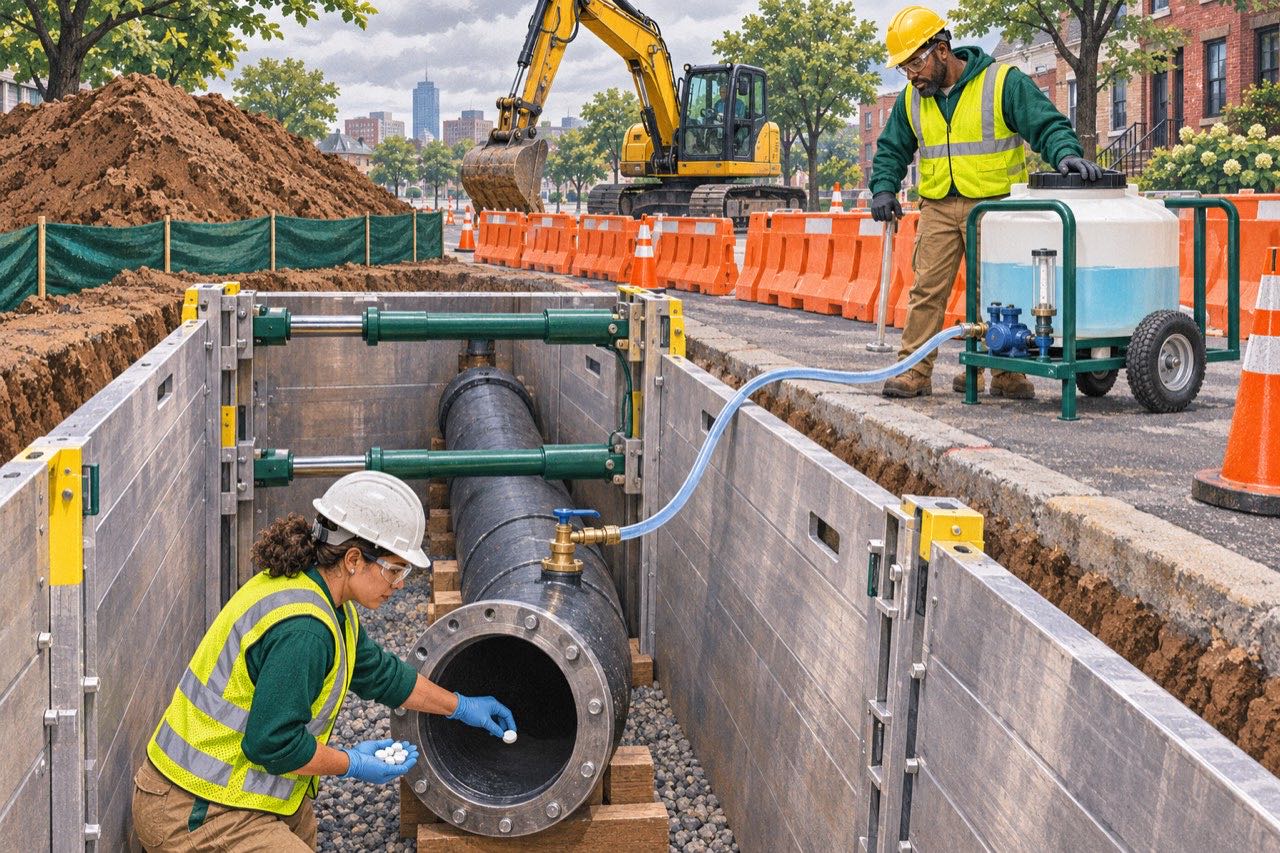
Water main disinfection means cleaning a new or repaired main, then filling it with strong chlorine before it carries drinking water. AWWA Standard C651, which states such as Pennsylvania require, allows three common methods. Tablet: calcium hypochlorite tablets placed as the pipe is laid. Continuous feed: at least 25 mg/L, held 24 hours, with at least 10 mg/L left at the end. Slug: at least 100 mg/L moved through the main so every part gets at least 3 hours of contact. The main then gets flushed (with the chlorinated water dechlorinated before discharge) and goes into service only after bacteriological samples pass.
Key takeaways
- Order of work: pressure test, disinfect, flush, then bacteriological samples. Service starts only after samples pass.
- Continuous feed: at least 25 mg/L, held 24 hours, with at least 10 mg/L remaining.
- Slug method: at least 100 mg/L, with at least 3 hours of contact everywhere in the main.
- Pounds of chlorine = MG x mg/L x 8.34. Divide by product strength to get product.
- Dechlorinate heavily chlorinated water before it reaches a storm drain or stream.
- If samples show coliform, flush and resample. Rechlorinate if they stay positive.
What is the water main disinfection procedure?
Pennsylvania DEP's distribution training sums up the order for a new main: repair or install, backfill, pressure test, disinfect, flush, and collect bacteriological samples. The main does not carry customer water until those samples pass. Water suppliers there must follow AWWA Standard C651, which covers flushing, disinfection, and microbiological testing.
Cleaning comes first. C651 calls for a preliminary flush at a velocity of at least 3.0 ft/s, as quoted in Iowa's SUDAS specification and Ontario's procedure. Pennsylvania's workbook says new mains should be flushed at least 5 ft/s for about 30 minutes. If you can't reach a scouring velocity, PA DEP's disinfection module says to clean the main by pigging instead.
During construction, keep dirt, trench water, and animals out of the pipe. Plug open ends whenever the crew walks away.
What are the three AWWA C651 disinfection methods?
C651 itself is a paid standard, so the numbers below come from documents that adopt it: Pennsylvania DEP and Iowa SUDAS for the 25 mg/L, 24-hour figures, and Ontario's provincial procedure (Table 1) for the slug figures. We could not find a US state document that prints the slug numbers. Your state or utility spec may add to them, so always check the job specification.
- Tablet method: some specs restrict it. Iowa SUDAS allows it only with the engineer's approval.
- Continuous feed: the method in Pennsylvania's disinfection module. Hold the solution 24 hours and operate every valve and hydrant so they get disinfected too. If the 24-hour residual is not above 10 mg/L, rechlorinate.
- Slug method: Ontario's procedure, which adopts C651, has crews stop the flow and add chlorine if the slug drops more than 25 mg/L.
| Method | How it works | Starting chlorine | Contact time | End check |
|---|---|---|---|---|
| Tablet | Calcium hypochlorite tablets glued to the top of each pipe length with food-grade adhesive as the pipe is laid | At least 25 mg/L | 24 hours | Residual measured at the end of the hold |
| Continuous feed | Chlorine is fed into water entering the main until the whole main holds the target | At least 25 mg/L free chlorine | 24 hours | At least 10 mg/L remaining, or rechlorinate |
| Slug | A slug of highly chlorinated water is moved through the main | At least 100 mg/L | At least 3 hours at every point | Measured as the slug moves; add chlorine if it drops |
How do you do water main disinfection calculations?
Every disinfection problem uses the same chain: pipe volume, then million gallons, then pounds of chlorine, then pounds or gallons of product. Here's a new 8-inch main, 1,000 ft long, dosed at 25 mg/L with 12.5% sodium hypochlorite.
Step 1, volume. 8 in ÷ 12 = 0.667 ft. Volume = 0.785 × (0.667 ft)² × 1,000 ft = 348.9 ft³ (exactly 0.785 × 4/9 × 1,000). Then 348.9 ft³ × 7.48 gal/ft³ = 2,609.7 gal, or 0.0026097 MG.
Step 2, pounds of chlorine. lb = MG × mg/L × 8.34 = 0.0026097 × 25 × 8.34 = 0.544 lb of chlorine.
Step 3, pounds per gallon of product. Liquid bleach weighs more than water. PA DEP's hypochlorite module works its example with a 12.5% product at a specific gravity of 1.15: 1.15 × 8.34 = 9.59 lb/gal, and 9.59 × 0.125 = 1.199 lb of available chlorine per gallon (PA rounds to 1.2). Use the specific gravity on your product's SDS.
Step 4, gallons of product. 0.544 lb ÷ 1.199 lb/gal = 0.454 gal, about 0.45 gallon or 58 fluid ounces (0.454 × 128). All values are rounded to three significant figures at the end, not between steps.
Run the same main as a slug at 100 mg/L and the chlorine is four times larger: 0.0026097 × 100 × 8.34 = 2.18 lb of chlorine, or 1.82 gal of the same 12.5% product. If you use 65% calcium hypochlorite instead, divide pounds of chlorine by 0.65: at 25 mg/L that is 0.544 ÷ 0.65 = 0.84 lb of granules. These figures cover the dose alone. Any chlorine demand in the main uses up part of it, which is why the residual is checked at the end.
What is the flushing water mains procedure after disinfection?
After the hold, the strong chlorine has to come out. Iowa SUDAS has crews flush with potable water until the chlorine residual matches the existing system. Pennsylvania's workbook suggests flushing through one or more hydrants at about 5 ft/s for two or three complete changes of water, until it runs visibly clean.
Where the water goes matters. PA DEP says chlorinated water can't be discharged straight to surface waters or storm sewers, and its disinfection module explains why: some fish, such as trout and salmon, tolerate only trace amounts of chlorine (about 0.01 mg/L). Kentucky's operator manual says to always dechlorinate when flushing, commonly with sodium thiosulfate. Pennsylvania notes hydrants can be fitted with dechlorination devices that hold tablets, typically sodium sulfite or ascorbic acid. Check your local discharge rules and the sewer utility's conditions before you open a hydrant.
How is bacteriological sampling done before service?
After the final flush, the main is refilled with system water and sampled for coliform bacteria. Pennsylvania notes the test takes at least 24 hours from the time of sampling. The details vary by state. Iowa's SUDAS spec, which follows C651 with changes, takes sample sets about every 1,200 ft of new main and at the end of the line. It then takes a second set after at least 24 hours with no water use, or 16 hours if the engineer allows.
If samples fail, don't simply open the valve and hope. SUDAS calls for flushing again and resampling, then rechlorinating if coliform is still present. Pennsylvania's module says to repeat the procedure as required. The main goes into service only after both sample sets pass and the jurisdiction gives approval.
What changes for a main break or repair?
A repair can't sit for 24 hours, so the steps are shorter. Pennsylvania's disinfection module says to put hypochlorite in any water in the open trench and swab the inside of all pipe, fittings, and valves with a 1% hypochlorite solution. Then flush through the nearest hydrants and take bacteriological samples. If a sample is positive, evaluate corrective action and sample daily until two negative samples are recorded. Pennsylvania's distribution workbook adds that the best repairs are made under system pressure with water flowing, which keeps contamination out.
Practice this now — free
Practice disinfection math before exam day
Pipe volume, pounds of chlorine, and hypochlorite strength show up on every distribution exam. Drill them in the free math practice test.
Take the free math practice test →Frequently asked questions
What is the slug method of water main disinfection?
In C651-based procedures such as Ontario's, a slug of water holding at least 100 mg/L of chlorine is moved through the main so every part of the main gets at least 3 hours of contact. Crews measure the chlorine as the slug moves and add more if it drops.
How long does chlorine stay in a new water main?
For the tablet and continuous feed methods, 24 hours. Pennsylvania's module calls for at least 10 mg/L to remain after 24 hours from a starting dose of at least 25 mg/L. For the slug method, at least 3 hours at every point.
How do you calculate chlorine for a new water main?
Find the volume (0.785 × D² × length × 7.48 gal/ft³), convert to million gallons, then multiply by mg/L and 8.34 to get pounds of chlorine. Divide by product strength. An 8-inch main 1,000 ft long needs 0.544 lb of chlorine at 25 mg/L.
Why must chlorinated water be dechlorinated before discharge?
Heavily chlorinated water kills fish and aquatic life. Pennsylvania notes some species tolerate only about 0.01 mg/L. Sodium thiosulfate, sodium sulfite, or ascorbic acid are common neutralizers. Follow your local discharge rules.
Can a new main go into service before the bacteria results come back?
No. The main is placed in service only after the bacteriological samples pass. Some specs, such as Iowa SUDAS, require two passing sets of samples.
Sources
- PA DEP Drinking Water Operator Certification Training, Module 5: Disinfection (workbook) ↗
Pipelines: 25 mg/L minimum, 24 h, residual above 10 mg/L, dechlorinate, bacteriological samples; repairs: 1% swab, daily sampling until two negatives; fish tolerance ~0.01 mg/L
- PA DEP Drinking Water Operator Certification Training, Module 8: Distribution System (workbook) ↗
Must follow AWWA C651; sequence; flushing about 5 ft/s, 2-3 volumes; no discharge to streams or storm sewers; dechlorination tablets; bac-T at least 24 h; repairs under pressure
- PA DEP Drinking Water Operator Certification Training, Module 25: Hypochlorite (workbook, rev. 2022) ↗
12.5% sodium hypochlorite; SG 1.15 example giving 1.2 lb available chlorine per gallon; lb = MG x mg/L x 8.34
- Ontario Watermain Disinfection Procedure (adopts ANSI/AWWA C651) ↗
Table 1: tablet/continuous feed 24 h at 25 mg/L or more; slug 3 h at 100 mg/L or more; slug decrease limit 25 mg/L; C651 preliminary flush 3.0 ft/s
- Iowa SUDAS Standard Specifications, Section 5030 Testing and Disinfection ↗
Disinfect per C651; tablet only with approval; 25 mg/L, 24-48 h; 3 ft/s flush; final flush to system residual; dechlorinate; sampling every 1,200 ft, two sets 24 h (or 16 h) apart; re-disinfection
- Kentucky Distribution System Operator Certification Manual (rev. 2013) ↗
Tablets glued to top of pipe with food-grade glue; always dechlorinate when flushing; sodium thiosulfate
Mainsora is independent exam preparation, not affiliated with ABC/WPI, AWWA, EPA or any state certification program. Requirements change — confirm with your state program. See our editorial policy.