Backflow Prevention Devices: Which One Stops What
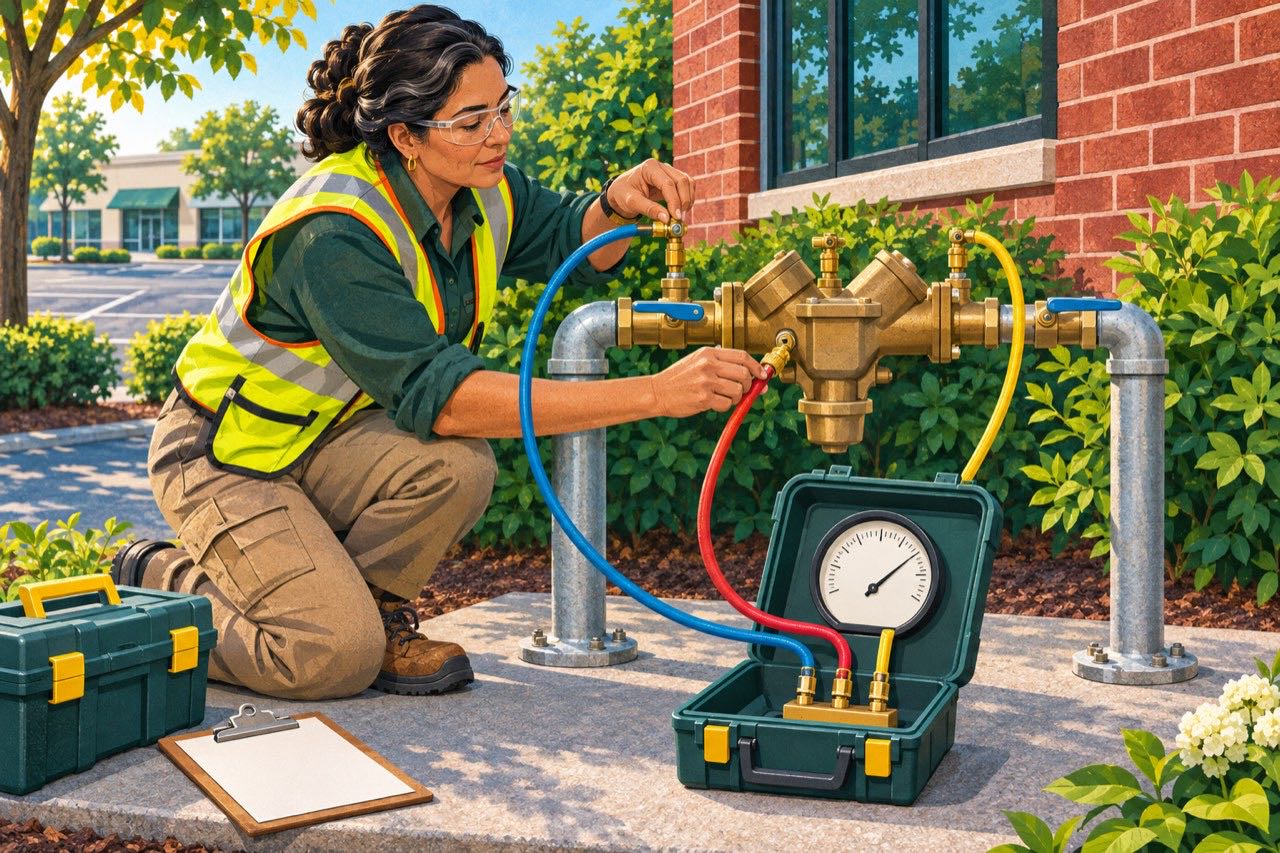
Backflow prevention devices keep water from flowing backward out of a customer's plumbing into the public water system. You pick one by asking two questions. Is the hazard a health hazard (a contaminant) or a non-health hazard (a pollutant)? And can backpressure happen, or only backsiphonage? An air gap or a reduced-pressure principle (RP) assembly handles both causes and health hazards. A double check handles both causes but only non-health hazards. Vacuum breakers stop backsiphonage only.
Key takeaways
- Backsiphonage: supply pressure drops below atmospheric and pulls. Backpressure: the customer side pushes harder than the main.
- An air gap must be at least twice the supply pipe diameter and never less than 1 inch.
- Air gap and RP: health hazards, both backsiphonage and backpressure.
- Double check: both causes, but only for low (non-health) hazards.
- PVB, SVB and AVB: backsiphonage only. An AVB can't have a shutoff valve downstream.
- Testing intervals come from state and local rules. Washington and Ohio, for example, require a test at least once a year.
What causes backflow: backsiphonage vs backpressure?
Backflow is water or another substance flowing into the drinking water pipes from somewhere other than the intended source. EPA's Cross-Connection Control Manual describes two causes, and every device question on the exam depends on telling them apart.
Backsiphonage happens when the supply side drops to a partial vacuum, meaning below atmospheric pressure. Air pressure then pushes the liquid on the customer side back toward the main. Main breaks, heavy fire flow, and draining a main for repair all cause it. Homes on high ground lose pressure first.
Backpressure happens when the customer's piping is at higher pressure than the supply, so water flows from the higher-pressure zone to the lower one. A booster pump, a boiler, or a pump drawing from a pond can do it while the main is still positive.
Backflow also needs a cross-connection: any actual or potential link between the public water supply and a source of contamination or pollution, such as a hose lying in a pool. A practical test for any case is to ask which side changed. If the main went low, it's backsiphonage. If the customer side went high, it's backpressure.
What is the degree of hazard?
The second question is how bad the backflow would be. EPA's model cross-connection program defines a contaminant as a substance that creates a serious health hazard, leading to poisoning or the spread of disease. A pollutant is a moderate hazard: it degrades the water or makes it less usable but does not create an actual health hazard.
States use their own labels for the same idea. Washington's guide sorts customers into high and low health hazards and requires high-hazard premises to be isolated with an air gap or an RP. Ohio uses four levels: severe health, health, system, and pollutional hazards, where pollutional means objectionable but not dangerous to health. EPA's examples help: pesticides and termite treatments are household health hazards, while EPA lists food processing steam kettles and apartment projects as typical low-to-medium hazards for a double check.
Which backflow prevention devices protect against what?
Combine the two answers and the choice narrows quickly. The table summarizes EPA's device descriptions, Washington's premises-isolation guide, and Ohio's containment table. Your state or local code can be stricter, so check it.
| Device | Health hazard? | Backsiphonage | Backpressure | Testable? |
|---|---|---|---|---|
| Air gap (AG) | Yes | Yes | Yes | No test cocks, but must be inspected |
| Reduced-pressure principle (RP) | Yes | Yes | Yes | Yes |
| Double check valve assembly (DC) | No, low hazard only | Yes | Yes | Yes |
| Pressure vacuum breaker (PVB) | Used for fixture isolation, e.g. irrigation | Yes | No | Yes |
| Spill-resistant vacuum breaker (SVB) | Same as PVB, for indoor use | Yes | No | Yes |
| Atmospheric vacuum breaker (AVB) | Used for fixture isolation | Yes | No | No |
How does an air gap work, and how big must it be?
An air gap is open air between the end of the supply pipe and the flood rim of the tank or fixture it fills. With no pipe connection, nothing can be pushed or pulled back, so it stops both backsiphonage and backpressure. EPA calls it very effective.
The rule: the gap must be at least twice the supply pipe diameter ("2D") and never less than 1 inch. A 2-inch fill line needs at least 4 inches. A 3/8-inch line works out to 3/4 inch, so the 1-inch minimum applies.
Air gaps have costs. The water loses its pressure, so you need a tank and often a second pump. Someone can also defeat the gap by pushing the pipe down into the tank to stop splashing. EPA says air gaps must be inspected as often as mechanical backflow preventers.
RP assembly vs double check: what is the difference?
A double check valve assembly has two spring-loaded check valves, two tightly closing shutoff valves, and test cocks. EPA says each check takes about a pound of pressure to open. A DC works under constant pressure and stops both backsiphonage and backpressure, but EPA lists it for low to medium hazards. Washington's and Ohio's tables don't accept a DC where there is a health hazard.
A reduced-pressure principle assembly adds a relief valve that vents to air from the zone between the two checks. That zone always stays at least 2 psi below supply pressure. If both checks foul, the relief valve dumps water out instead of letting it reach the main. EPA calls it maximum protection, suitable for high-hazard installations.
Because the relief valve discharges water, location matters. Ohio's manual requires a visible free discharge from the relief port, adequate floor drainage, and no installation in pits. Its general guideline puts backflow assemblies 12 to 30 inches above the finished floor.
PVB, SVB and AVB: when is a vacuum breaker enough?
Vacuum breakers let air into the pipe when supply pressure drops, which breaks the siphon. None of them stops backpressure, so they only fit where no pump, boiler, or elevated tank can push back.
- Atmospheric vacuum breaker (AVB): a float that drops to open a vent when flow stops. EPA says it must be installed vertically, at least 6 inches above the final outlet, with no shutoff valve downstream, and it can't be tested in line. Ohio limits it to no more than 12 hours under pressure in any 24.
- Pressure vacuum breaker (PVB): a spring-loaded air inlet plus a check, with shutoffs and test cocks. It can stay under constant pressure, so valves may be downstream. Ohio requires it at least 12 inches above the flood level rim and accepts it only for isolation, not containment at the service.
- Spill-resistant vacuum breaker (SVB): EPA describes it as a PVB variant built to minimize spillage, recommended for indoor use.
- Hose bibb vacuum breaker: a small atmospheric-type device that screws onto a hose faucet to protect against backsiphonage from garden hoses and sprayers.
How does a cross-connection control program run?
Devices only work inside a cross connection control program. EPA's Distribution System Toolbox lists the core elements: legal authority to require and enforce devices, trained and certified personnel, recordkeeping for tests and repairs, and public education. Rules on allowed devices, testing frequency, and repairs vary from state to state.
Programs protect the main in two ways. Containment puts one assembly at the service entrance to keep anything in the building out of the public system. Fixture isolation puts a device at the hazard itself inside the building. Ohio's manual notes that containment protects only the public supply, not the people drinking water inside the building.
Testing intervals come from state and local rules, not from a single national number. Washington's rule (WAC 246-290-490) requires testing at installation, at least once a year after that, after a backflow incident, and after an assembly is repaired, reinstalled, or relocated. Ohio requires testing at least every twelve months. EPA's model program goes further for RPs, calling for a test at least every six months. Your state may differ, so check its rule.
Practice this now — free
Practice backflow questions the way the exam asks them
Device choice, air gap math, and backsiphonage vs backpressure show up on distribution exams. Try them in a free timed practice test.
Take the free practice test →Frequently asked questions
What is the difference between a backflow prevention device and an assembly?
In program language, an assembly has in-line shutoff valves and test cocks, so it can be tested where it's installed: RP, double check, PVB and SVB. Devices such as atmospheric and hose bibb vacuum breakers have no test cocks and are inspected rather than tested.
Which backflow preventer protects against both backsiphonage and backpressure on a health hazard?
Only an air gap or a reduced-pressure principle (RP) assembly. A double check also stops both causes, but it is limited to non-health hazards.
How big does an air gap have to be?
At least twice the diameter of the supply pipe and never less than 1 inch, measured from the pipe outlet to the flood rim. A 2-inch pipe needs at least 4 inches.
Can a vacuum breaker stop backpressure?
No. Atmospheric, pressure, and spill-resistant vacuum breakers protect against backsiphonage only. Where a pump, boiler, or elevated tank could push water back, use an RP, a double check (low hazard only), or an air gap.
How often are backflow assemblies tested?
It is set by state and local rules. Washington and Ohio, for example, require a test at installation and at least once a year. Washington also requires one after repairs and after backflow incidents. Some programs test RPs more often.
Sources
- EPA Cross-Connection Control Manual (EPA 816-R-03-002) ↗
Backsiphonage and backpressure theory; air gap 2D, never less than 1 inch; AVB, PVB, SVB, DC and RP descriptions; model program definitions of contaminant, pollutant, containment, fixture isolation; RP testing at least semi-annually in the model program
- EPA Distribution System Toolbox: Cross-Connection Control and Backflow Prevention (EPA 815-F-21-004) ↗
Program elements; rules vary by state
- Washington DOH, Cross-Connection Control for Small Water Systems (331-234) ↗
High/low health hazard; AG or RPBA for high-hazard premises isolation; Table 1; WAC 246-290-490 testing frequency
- Ohio EPA Manual of Backflow Prevention and Cross-Connection Control (2015) ↗
Hazard levels; Table 2; PVB 12 inches above flood rim and isolation only; AVB 12 hours in 24; RP 12 to 30 inches above floor; testing every twelve months
Mainsora is independent exam preparation, not affiliated with ABC/WPI, AWWA, EPA or any state certification program. Requirements change — confirm with your state program. See our editorial policy.