Water Treatment vs Water Distribution Operator: Differences
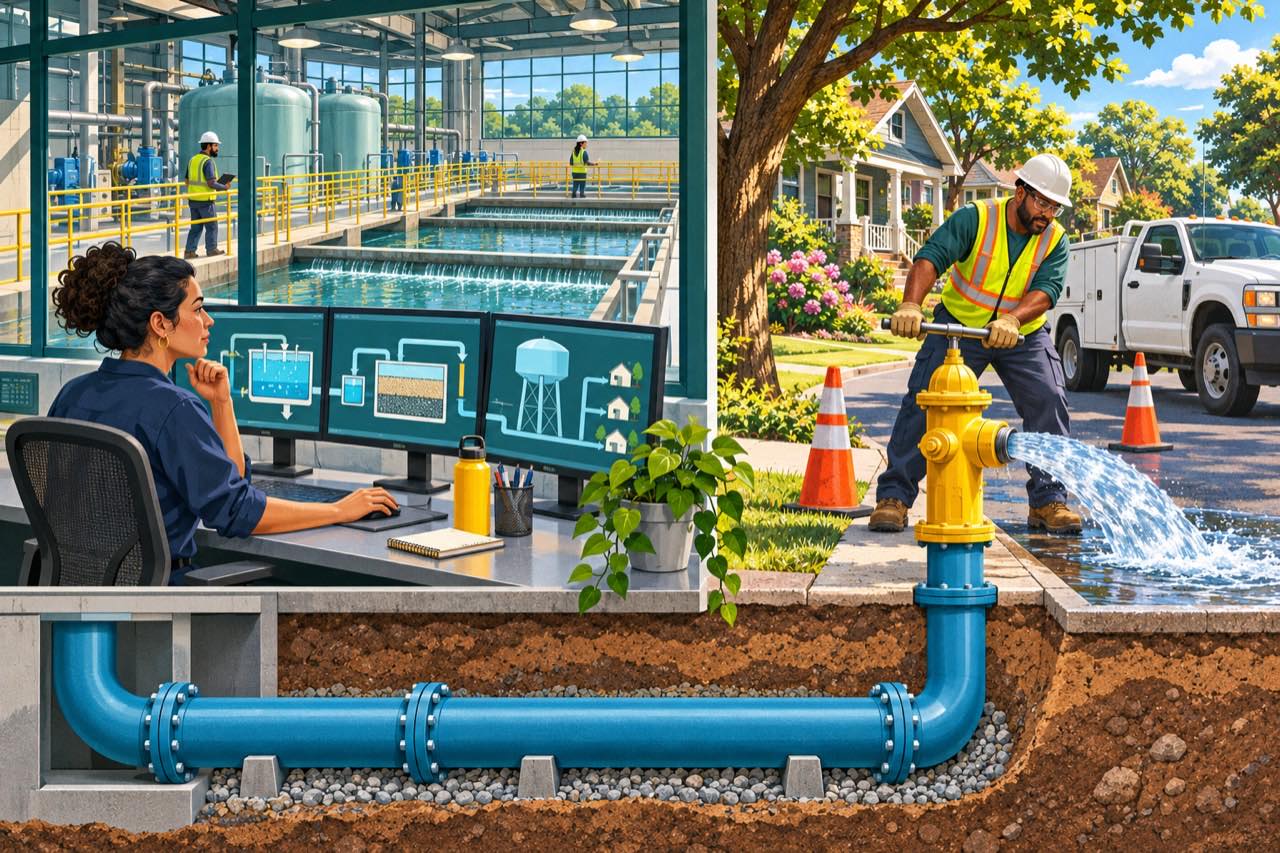
Water treatment vs water distribution operator comes down to where the water is. A treatment operator runs the plant that turns raw water into safe drinking water; a distribution operator runs the mains, valves, hydrants, tanks, pumps and meters that carry that water to customers. Most states issue separate treatment and distribution licenses with different exams, but some, such as Minnesota, Mississippi, Nebraska and Virginia, use one combined license series.
Key takeaways
- Treatment is the plant: coagulation, settling, filtration, disinfection and lab work.
- Distribution is the network after the plant: mains, valves, hydrants, storage, pumps, meters, sampling and backflow control.
- Both exams test disinfection and chlorine residual, but the rest of the content is different.
- Most states license treatment and distribution separately; a few combine them, and some offer a combined grade for small systems.
- Get the license that matches the system you work on now, because experience usually has to come from that kind of work.
What is the difference between water treatment and water distribution?
Think of a public water system as two halves joined by a pipe. The treatment half takes water from a river, lake or well and makes it safe to drink. The distribution half stores that finished water and moves it under pressure to every home, business and fire hydrant.
EPA describes a distribution system as an interconnected series of components, including pipes and storage facilities, with mains carrying water from the treatment plant (or straight from the source when no treatment is used) to consumers. BLS describes water treatment operators as people who run the equipment, control the processes and monitor the plants that treat water to make it safe to drink.
People sometimes search for the difference between water supply and water distribution. Water supply is a broad term for the whole system, from source to tap, and some states use it as a license name. Ohio, for example, calls its treatment certificates water supply (Class A and I-IV) and certifies water distribution separately. Distribution is the part after treatment.
Water treatment vs water distribution operator: side by side
The table compares the two jobs using the national certification exam outlines and federal sources. Your state's rules decide the exact license names and grades.
| Water treatment operator | Water distribution operator | |
|---|---|---|
| Where you work | Treatment plant, wells, chemical feed rooms, lab | Streets, trenches, vaults, tanks, pump stations |
| Core equipment | Mix basins, clarifiers, filters, chemical feeders | Mains, valves, hydrants, meters, service lines, tanks, pumps |
| Typical tasks | Adjust chemical feed rates, run process control tests, troubleshoot process units | Flush mains, repair breaks, read meters, collect samples, run cross-connection control |
| Chlorine | Dose it and keep it at the right level in the plant | Keep a residual all the way to the tap; disinfect new mains and repairs |
| Exam focus | Treatment processes, lab analysis, source water, regulations | System components, installation and repair, water quality, safety and public |
| Safety emphasis | Chemical handling, plant equipment | Traffic control, excavation, confined spaces |
| License | Treatment grades (for example, T1-T5 in California) | Distribution grades (for example, D1-D5 in California) |
How do the treatment and distribution exams differ?
Many states use exams from Water Professionals International (WPI, formerly the Association of Boards of Certification, ABC). Its Class I distribution exam has 100 scored questions in four content areas: Distribution System Components (35), Equipment Installation, Operation, Maintenance, and Repair (30), Water Quality Monitoring, Evaluation, Adjustment, and Laboratory Analysis/Interpretation (15), and Security, Safety, Administrative Procedures, and Public Interactions (20). About 9 percent of the items are calculations.
The ABC need-to-know criteria for water treatment operators (2007 edition) group the treatment job into different duties: monitoring, evaluating and adjusting treatment processes, laboratory analysis, evaluating source water characteristics, complying with drinking water regulations, operating and maintaining equipment, and safety and administrative procedures. The treatment process list covers coagulation and flocculation, sedimentation, filtration, fluoridation and other processes a distribution exam does not ask about.
The overlap is real but narrow. Both exams expect you to understand chlorine disinfection, chlorine residual and basic math. Distribution exams lean toward pipe hydraulics, volumes and flow rates in mains and tanks; treatment exams lean toward dosage rates and process control calculations. Our formula page covers the distribution side, and our free lesson on how height becomes pressure is a good place to start.
Are treatment and distribution separate licenses?
In most states, yes. A few states use one combined license series, and several others keep separate licenses but offer a combined option for small systems. The examples below come from our state guides, where each state's record links to its official rules.
| Approach | State examples |
|---|---|
| Separate treatment and distribution licenses | California: treatment T1-T5, distribution D1-D5. Ohio: water supply (treatment) is separate from water distribution. Arkansas: operators who do both treatment and distribution duties need both licenses. |
| One combined license series | Minnesota: one A-E water supply series covers treatment and distribution. Mississippi: one waterworks series (Class A-E). Nebraska: one water operator license, Grades I-V. Virginia: waterworks license, no separate distribution license. |
| Separate, with a combined option | New Hampshire: Grade I-A combines both for the smallest systems. Kentucky: combined treatment/distribution certificates (I-AD, I-BD, II-BD). Iowa: an operator in charge of both holds a combined certificate showing both. Wyoming: Level 1 Water Treatment also covers Level 1 distribution. |
Which should you get first, treatment or distribution?
Start with the license that matches the job you have or want. Experience requirements are usually tied to the kind of system you work on, so a crew member on a utility's distribution team builds distribution experience, not treatment experience.
South Dakota makes this explicit: distribution workers cannot sit for treatment exams without treatment experience. Ohio shows how one license can help with another: a holder of an equal or higher certificate in another field may get a 50 percent reduction in the experience needed for Class II distribution, but still needs one year in distribution.
If you are new and choosing a career path, compare the work rather than the paper. Treatment suits people who like process control, chemistry and lab work inside a plant. Distribution suits people who like hands-on field work: excavations, valves, hydrants and customer calls. BLS notes that plants run 24 hours a day, 7 days a week, so rotating shifts are common, and that workers in this field may need to be on call for emergencies.
Can you hold both a treatment and a distribution license?
In many states you can, and on small systems one person often needs both. Rules for keeping both current vary, so check your state guide before you plan your training hours.
Some states make holding both easier. Maine licenses treatment and distribution under the same board, and an operator holding both needs only one set of training hours. In California, contact hours can count toward both a treatment and a distribution certificate. New York operators holding two certifications meet the continuing education requirement of the higher grade.
Others keep them strictly apart. In Florida, distribution continuing education units cannot be shared with a treatment license. Alabama's rules say an operator may hold only one water and one wastewater certificate, so read your state's rules closely before you plan on two water licenses there.
Practice this now — free
Going the distribution route?
Try exam-style distribution questions free, with an explanation for every answer.
Take the free practice test →Frequently asked questions
Is water treatment harder than water distribution?
Neither is simply harder. Treatment exams cover more chemistry and plant processes such as coagulation, settling and filtration; distribution exams cover pipes, hydraulics, valves, hydrants, safety and customer work. Most people find the exam that matches their daily work easier.
Can a distribution operator work at a treatment plant?
Not as the certified treatment operator unless they also hold a treatment license, or a combined license in a state that uses one. In most states treatment and distribution are separate licenses with separate exams.
Which states combine water treatment and distribution licenses?
Examples include Minnesota, Mississippi, Nebraska and Virginia, which use one combined license series. New Hampshire, Kentucky and Iowa keep separate licenses but offer a combined grade or certificate for some systems.
Do treatment and distribution exams both include chlorine questions?
Yes. Both test chlorine disinfection and chlorine residual. Distribution exams add keeping a residual through the pipes and disinfecting new mains and repairs.
What is a water distribution license?
It is a state certificate that allows you to operate a public drinking water distribution system at a given grade. Grades usually rise with system size and require more experience.
Sources
- WPI Need-to-Know Criteria: Water Distribution Operator Class I (2025, hosted by ADEM) ↗
Distribution exam content areas, question counts, 9% calculations, job tasks
- ABC Need-to-Know Criteria for Water Treatment Operators (2007) ↗
Treatment core competency groups and process list
- EPA: Drinking Water Distribution Systems ↗
Definition of a distribution system
- BLS Occupational Outlook Handbook: Water and Wastewater Treatment Plant and System Operators ↗
What treatment operators do; plants run 24/7 with rotating shifts; on call
- California State Water Resources Control Board: Drinking Water Operator Certification ↗
Separate T1-T5 and D1-D5 certificates (via the California state guide record)
- Minnesota Department of Health: Water Operator Certification ↗
One combined A-E water supply series (via the Minnesota state guide record)
- NHDES: Drinking Water Operator Certification ↗
Grade I-A combined treatment and distribution (via the New Hampshire state guide record)
- Ohio EPA Operator Certification ↗
Water supply vs water distribution certificates; Class II experience reduction (via the Ohio state guide record)
Mainsora is independent exam preparation, not affiliated with ABC/WPI, AWWA, EPA or any state certification program. Requirements change — confirm with your state program. See our editorial policy.