What Does a Water Distribution Operator Do? Duties and Pay
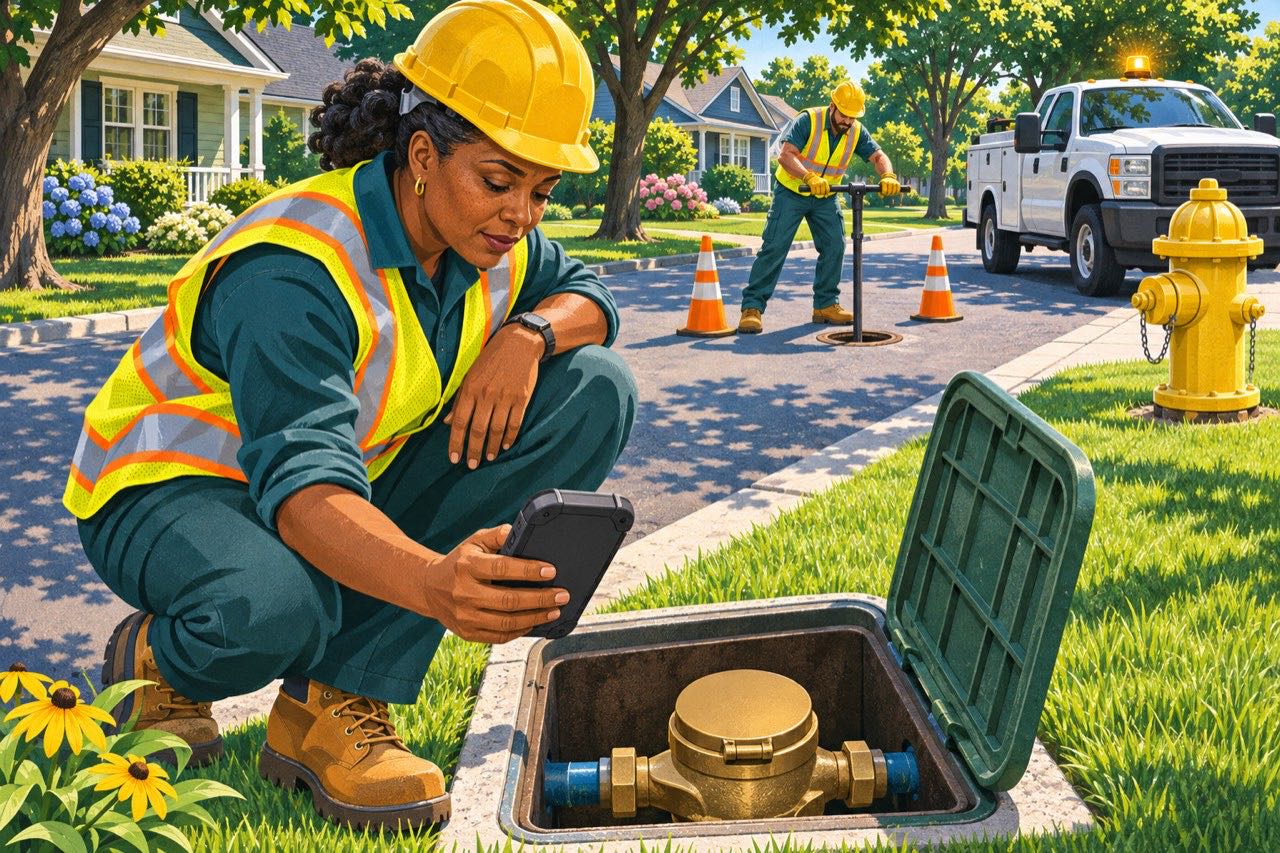
What does a water distribution operator do? A water distribution operator keeps treated drinking water safe and moving through the pipes between the treatment plant or well and the customer's tap. The work covers installing and repairing mains and service lines, exercising valves, flushing and maintaining hydrants, reading meters, collecting water-quality samples, supporting cross-connection control and responding to main breaks. Most states require a distribution operator license, issued in grades that rise with system size and experience.
Key takeaways
- A water operator runs part of a public water system; a distribution operator handles the pipes, valves, hydrants, tanks, pumps and meters after treatment.
- The national WPI (formerly ABC) Class I distribution exam is built from real job tasks such as flushing, meter reading, repairs, sampling and safety practices.
- BLS reports a median annual wage of $60,020 in May 2025 for water and wastewater treatment plant and system operators combined; it does not publish a distribution-only figure.
- BLS says the typical entry education is a high school diploma or equivalent, followed by long-term on-the-job training.
- Licensing rules, grades and experience requirements are set by each state.
What is a water operator, and what is a water distribution operator?
A water operator is a person who runs and maintains part of a public water system. Federal guidelines published by EPA in 1999 set baseline standards for state certification programs covering operators of community and nontransient noncommunity water systems, and EPA withholds 20 percent of a state's Drinking Water State Revolving Fund capitalization grant if the state has no operator certification program.
Drinking water operators usually split into two kinds of work. Treatment operators run the plant that makes raw water safe to drink. Distribution operators take over after that: they run the network that carries finished water to homes, businesses and fire hydrants.
EPA describes a distribution system as an interconnected series of components, including pipes and storage facilities, with mains carrying water from the treatment plant (or straight from the source when no treatment is used) to consumers. U.S. distribution systems span almost one million miles of pipe. If you want the side-by-side comparison, read our guide on water treatment vs water distribution operators.
What does a water distribution operator do day to day?
The best public description of the job is the outline of the national certification exam. Water Professionals International (WPI, formerly the Association of Boards of Certification, ABC) builds its Class I distribution exam from a study of the tasks operators actually perform. The table below groups those tasks into a plain-language water distribution job description.
A typical week might include flushing dead-end mains on one side of town, exercising valves on a route, reading meters, pulling routine bacteriological samples and then getting called out to a broken 8-inch main. No two days look the same, but every task comes back to the same goal: deliver safe water at good pressure.
| Duty | What it looks like in the field | Learn it |
|---|---|---|
| Mains and service lines | Install water lines and service taps, inspect new construction, repair mains and services | /learn/wd-mains-laying-thrust |
| Valves | Locate, operate and maintain valves, including pressure-regulating and air-relief valves | /learn/wd-valves-which-where |
| Hydrants | Install hydrants on new mains; maintain and repair them | /learn/wd-fire-hydrants |
| Flushing | Conduct distribution system flushing to move stale water and sediment out of mains | /learn/wd-mains-flush-breaks-clean |
| Meters | Read meters, replace meters, maintain remote readers | /learn/wd-meters-service-lines |
| Sampling | Collect regulatory samples; test chlorine residual and pH | /learn/wd-coliform-sampling |
| Backflow | Understand backflow prevention devices and help run a cross-connection control program | /learn/wd-backflow-how-it-happens |
| Storage and pumps | Inspect, clean and disinfect tanks; maintain and monitor pump stations | /learn/wd-storage-tanks |
| SCADA and monitoring | Understand SCADA components; watch pressure, flow, water age and tank levels | /learn/wd-water-hammer-scada-leaks |
Why is sampling and backflow control part of the job?
Water can be perfect when it leaves the plant and still pick up problems in the pipes. That is why distribution operators collect samples out in the system, not just at the plant. Under the federal Revised Total Coliform Rule, each system needs a written sample siting plan with sites and a schedule representative of water throughout the distribution system.
The WPI Class I outline expects operators to collect regulatory and informational samples, test chlorine residual and pH, and interpret chlorine residual, chlorine demand and microbiological results. A typical field example is a chlorine residual test at a hydrant after flushing. Our free lesson on free, combined and total chlorine explains what those readings mean.
Backflow is the other big water-quality threat inside the network. If pressure drops during a main break, water from a customer's property can be pulled back into the main. Distribution operators need to understand backflow prevention devices and how a cross-connection control program works; start with our free lesson on how backflow happens.
What happens during a main break?
EPA notes that aging pipes deteriorate from corrosion, material erosion and outside pressures, which leads to breaches, intrusion during pressure swings and main breaks. When a main breaks, the distribution crew is the emergency response.
In practice that means locating the break, closing the right valves to isolate the smallest possible section, setting up traffic control, excavating safely, repairing the pipe, disinfecting the repair parts and flushing before the line goes back in service. The WPI outline also expects operators to inform customers of planned repairs or service disruptions and to handle customer questions about pressure and water quality.
Many utilities track pressure, flow and tank levels on SCADA (supervisory control and data acquisition) screens, and the WPI Class I outline lists understanding SCADA system components as a tested task. A sudden pressure drop on a SCADA trend is often the first sign of a break.
What are the working conditions like?
Distribution work happens mostly outdoors, in streets, trenches, vaults and pump stations. BLS says water and wastewater operators work both indoors and outdoors, that the work can be physically demanding and in hard-to-reach places, and that workers may need to be on call for emergencies.
Safety is a large share of the job and of the exam. The WPI outline lists safety practices such as traffic control, confined spaces, hazmat, lockout/tagout and excavation, plus securing facilities and investigating tampering. Under OSHA's excavation standard, every worker in an excavation must be protected from cave-ins by an adequate protective system, with exceptions only for stable rock or trenches less than 5 feet deep where a competent person finds no sign of a potential cave-in.
- Trench and excavation work during main repairs and new installations
- Confined spaces such as valve vaults and meter pits
- Traffic control while working in the street
- Chlorine handling when disinfecting new mains and repairs
- After-hours call-outs for breaks and low-pressure complaints
How much does a water distribution operator make?
The U.S. Bureau of Labor Statistics (BLS) does not publish a separate figure for distribution operators. It groups them with plant operators in one occupation, Water and Wastewater Treatment Plant and System Operators (SOC 51-8031), which includes both water and wastewater workers.
For that combined group, BLS reports a median annual wage of $60,020 in May 2025, or $28.86 per hour. The lowest 10 percent earned less than $39,110 and the highest 10 percent earned more than $91,060. Local government employed 74 percent of these workers, and the median wage in local government was $60,300.
Pay for a certified water operator varies by state, by employer and by license grade. BLS does not break these national figures down by license level, so treat them as a broad guide rather than an offer you should expect.
| BLS measure (May 2025 unless noted) | Value |
|---|---|
| Median annual wage | $60,020 |
| Median hourly wage | $28.86 |
| Lowest 10 percent earned less than | $39,110 |
| Highest 10 percent earned more than | $91,060 |
| Median wage, local government | $60,300 |
| Jobs held (2025) | About 131,000 |
| Projected employment change, 2025-35 | -6 percent, with about 10,000 openings a year |
How do you become a water distribution operator?
BLS says these operators typically need at least a high school diploma or equivalent and long-term on-the-job training to become fully qualified. A state license is usually required, and state licenses typically have multiple levels that reflect experience and training.
The exam is where the duties above turn into questions. The WPI Class I distribution exam has 100 scored questions in four content areas: Distribution System Components (35), Equipment Installation, Operation, Maintenance, and Repair (30), Water Quality Monitoring, Evaluation, Adjustment, and Laboratory Analysis/Interpretation (15), and Security, Safety, Administrative Procedures, and Public Interactions (20). About 9 percent of the items are calculations, and up to 10 extra unscored pretest questions may be mixed in.
Each state sets its own path. In Ohio, for example, you can take the Class I or Class II distribution exam before you have the experience; passing makes you an operator in training with up to five years to finish it, and Class I requires one year of operating experience. Check your state's page on our state guides list, then try the free practice test to see how the job tasks show up as questions.
Practice this now — free
See the job as exam questions
Our free practice test turns the duties on this page into exam-style questions with explanations.
Take the free practice test →Frequently asked questions
What is a water distribution operator?
A water distribution operator is a worker, usually state-certified, who operates and maintains the part of a public water system that carries treated water to customers: mains, valves, hydrants, storage tanks, pumps, meters and service lines.
How much do water distribution operators make?
BLS does not report distribution operators separately. For water and wastewater treatment plant and system operators combined, the median annual wage was $60,020 in May 2025, or $28.86 per hour.
Do you need a college degree to be a water distribution operator?
No degree is typically required. BLS says these operators typically need a high school diploma or equivalent plus long-term on-the-job training, and a state license is usually required.
Is a water distribution operator a good job?
It depends on what you want. BLS projects employment for the combined water and wastewater operator group to decline 6 percent from 2025 to 2035, but still expects about 10,000 openings a year as workers retire or change jobs. The work is mostly outdoors and can include on-call emergency work.
What is on the water distribution operator exam?
On the WPI Class I distribution exam, the 100 scored questions cover distribution system components, equipment installation and repair, water quality monitoring and laboratory work, and safety, administration and public interactions. About 9 percent are calculations.
Sources
- BLS Occupational Outlook Handbook: Water and Wastewater Treatment Plant and System Operators ↗
Median pay $60,020 / $28.86 (May 2025), 10th and 90th percentiles, industry medians, 131,000 jobs, -6% outlook and 10,000 openings, education, training, licensing, work environment, SOC 51-8031
- WPI Need-to-Know Criteria: Water Distribution Operator Class I (2025, hosted by ADEM) ↗
Exam content areas and question counts, 9% calculations, pretest items, job tasks (flushing, meters, SCADA, sampling, backflow, safety)
- EPA: Drinking Water Distribution Systems ↗
Definition of a distribution system, almost one million miles, deterioration and main breaks
- EPA: About Operator Certification (January 2025 snapshot) ↗
1999 guidelines, community and NTNC systems, 20% DWSRF withholding
- 40 CFR 141.853 (Revised Total Coliform Rule sample siting plans) ↗
Sample sites representative of water throughout the distribution system
- OSHA 29 CFR 1926.652 Requirements for protective systems ↗
Cave-in protection and the under-5-feet exception
Mainsora is independent exam preparation, not affiliated with ABC/WPI, AWWA, EPA or any state certification program. Requirements change — confirm with your state program. See our editorial policy.